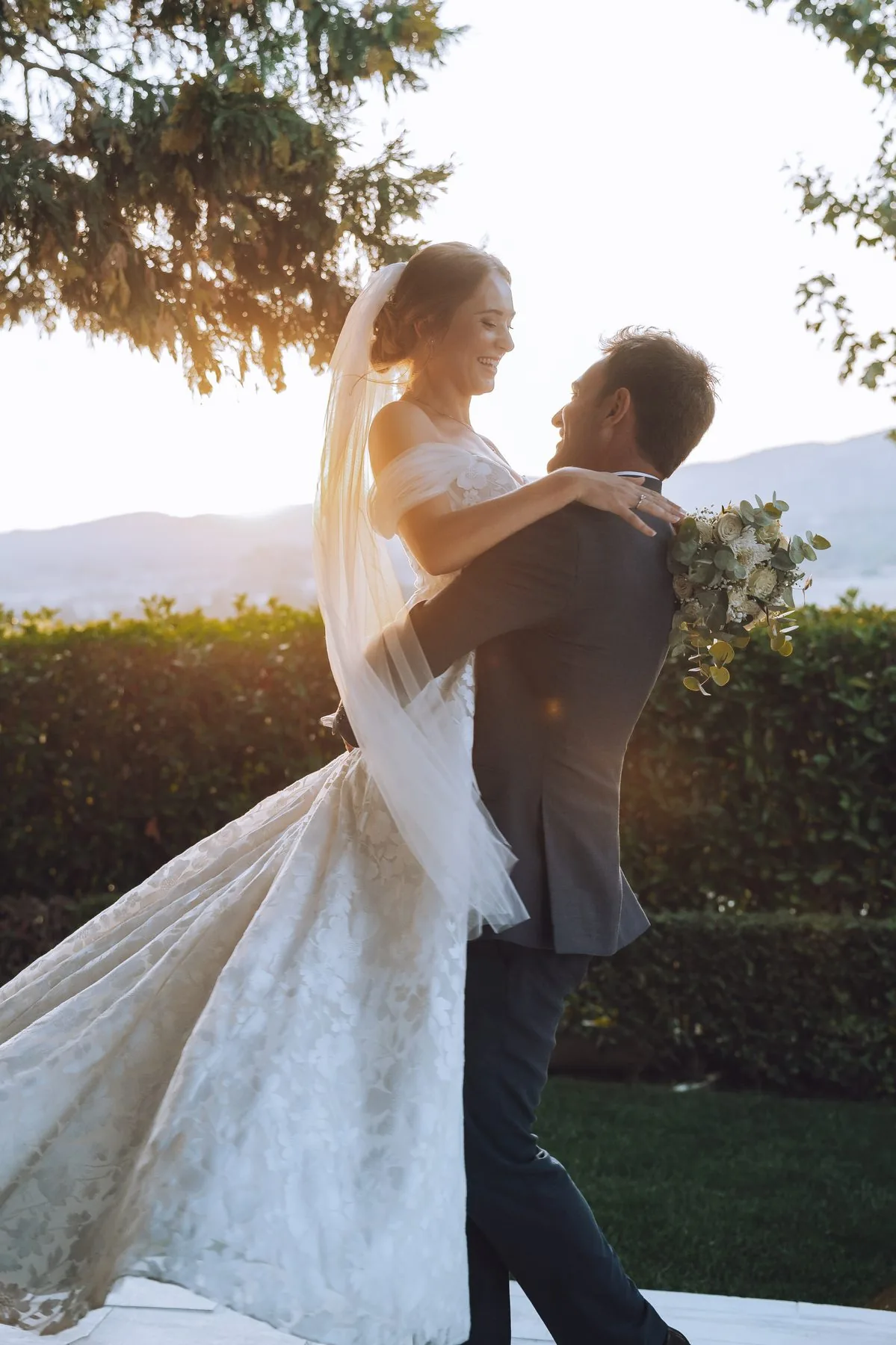
Every couple asks us the same question months before the wedding: what time should the ceremony be? The honest answer is that the ceremony is the last thing to decide. First comes the sun, because the light is the one thing on a wedding day that cannot be moved, booked or paid for twice.
This guide is written from behind the camera, for couples and wedding planners organising a destination wedding anywhere in Europe. It explains what golden hour really is, how long it lasts where you are marrying, and how to count back from it to a timeline that works. Further down there is a card you can fill in with your own date and place.
What golden hour actually is
Golden hour is not an hour, and it is not the sunset. It is the stretch of the evening when the sun is less than about six degrees above the horizon. The light has to cross so much atmosphere that it arrives warm, low and soft: it wraps around faces instead of carving them, and skin looks the way it does in memory.
How long it lasts depends on where you are and when. The further north, the longer the sun takes to set, so the golden light lingers. On the 15th of June it lasts about 38 minutes in Santorini, about 46 on Lake Como, about 55 in the Cotswolds and more than an hour in the Scottish Highlands. In September it shortens everywhere, to between 34 and 50 minutes.
After sunset comes the blue hour, when the sun is just below the horizon and the sky turns a deep, even blue. It ends when the sun reaches six degrees below, usually half an hour after sunset in southern Europe. It is short, and it is the most cinematic light of the night.
Golden hour and sunset across Europe
These are the times for some of the places where couples most often marry, on the 15th of June and the 15th of September. Notice how much they move: on the same June evening the sun sets more than an hour earlier on the Amalfi Coast than in Marbella, and in Scotland the golden hour starts after nine.
| Place | June · golden hour | June · sunset | September · golden hour | September · sunset |
|---|---|---|---|---|
| Lake Como, Italy | 20:30 | 21:16 | 18:58 | 19:37 |
| Tuscany, Italy | 20:14 | 20:57 | 18:50 | 19:28 |
| Amalfi Coast, Italy | 19:54 | 20:35 | 18:37 | 19:13 |
| Provence, France | 20:37 | 21:21 | 19:12 | 19:50 |
| Côte d'Azur, France | 20:31 | 21:15 | 19:06 | 19:44 |
| Paris, France | 21:06 | 21:56 | 19:25 | 20:07 |
| Santorini, Greece | 20:00 | 20:38 | 18:54 | 19:28 |
| Lisbon, Portugal | 20:24 | 21:04 | 19:12 | 19:47 |
| Algarve, Portugal | 20:16 | 20:55 | 19:09 | 19:43 |
| Mallorca, Spain | 20:39 | 21:19 | 19:25 | 20:01 |
| Marbella, Spain | 21:02 | 21:40 | 19:55 | 20:29 |
| Alicante, Spain | 20:48 | 21:28 | 19:38 | 20:13 |
| Cotswolds, England | 20:34 | 21:28 | 18:41 | 19:25 |
| Scottish Highlands, Scotland | 21:09 | 22:16 | 18:51 | 19:41 |
Count back from the light
Once you know when golden hour begins on your date, the rest of the day falls into place in four steps.
Your portraits. Start them a quarter of an hour before golden hour and keep them to twenty minutes. Weddings run late, almost always, and this margin means a delay of ten minutes still lands you in the best light rather than after it. Twenty minutes is enough for a full gallery and a film sequence, and short enough that your guests barely notice you have gone.
Family photographs. Straight after the ceremony, in the same place, while everyone is still there. Once guests have a glass in their hand and the cocktail has started, gathering them again takes twice as long. Fifteen minutes is enough with a list (more on that below).
The ceremony. Now count back the length of your ceremony. A civil or symbolic ceremony often takes fifteen to thirty minutes; a Catholic mass, around an hour; some religious ceremonies an hour and a half or more. The difference is not small: for the same portraits, a mass starts more than half an hour earlier than a short symbolic ceremony.
Everything else. Getting ready, the first look if you want one, the cocktail and dinner fit around those three fixed points. If the ceremony is in a church, the parish usually sets the hour; then the cocktail absorbs the difference, and the portraits stay where the light is.
Your own order of the light
Choose your date, your destination and how long your ceremony lasts. The card does the counting for you, with the four steps above, and you can send it to your planner as it is.
Would you rather see it as a day than as a card? Walk through your own day, hour by hour, with our photographs for every light.
A June wedding on the Mediterranean, hour by hour
Here is what that looks like on a real date: the 15th of June in Mallorca, with a thirty minute ceremony. Golden hour starts at 20:39 and the sun sets at 21:19.
For a September wedding in the same place, move everything about an hour and a quarter earlier. In Italy and Greece the evenings start earlier than in Spain or Portugal on the same date; in England and Scotland the summer light lasts much longer, and the day can breathe. The rhythm stays the same; only the clock moves.
The ceremony: it is not the hour, it is the orientation
In summer the sun is still well above the horizon during most ceremonies. What decides whether the photographs and the film of your vows are beautiful is where it sits. The best place for it is behind the two of you, or behind the guests with the altar in open shade. The worst is dappled light under a tree, which paints spots across faces that no edit can remove, and the second worst is the sun straight in your eyes.
We check the sun path for your exact date and hour with your planner during the site visit, and if needed we suggest turning the ceremony a few degrees. It is the cheapest decision of the whole wedding and one of the most visible.
We would rather have twenty minutes of good light than an hour of the wrong one.
Family photographs in fifteen minutes
A list of eight to ten groups, written in the order they will be photographed, with one person from each family who knows everyone by name. Start with the largest group and finish with grandparents, so nobody waits standing. Done where the ceremony took place, before anyone walks off to the cocktail, the whole list takes about fifteen minutes.
The night has its own light
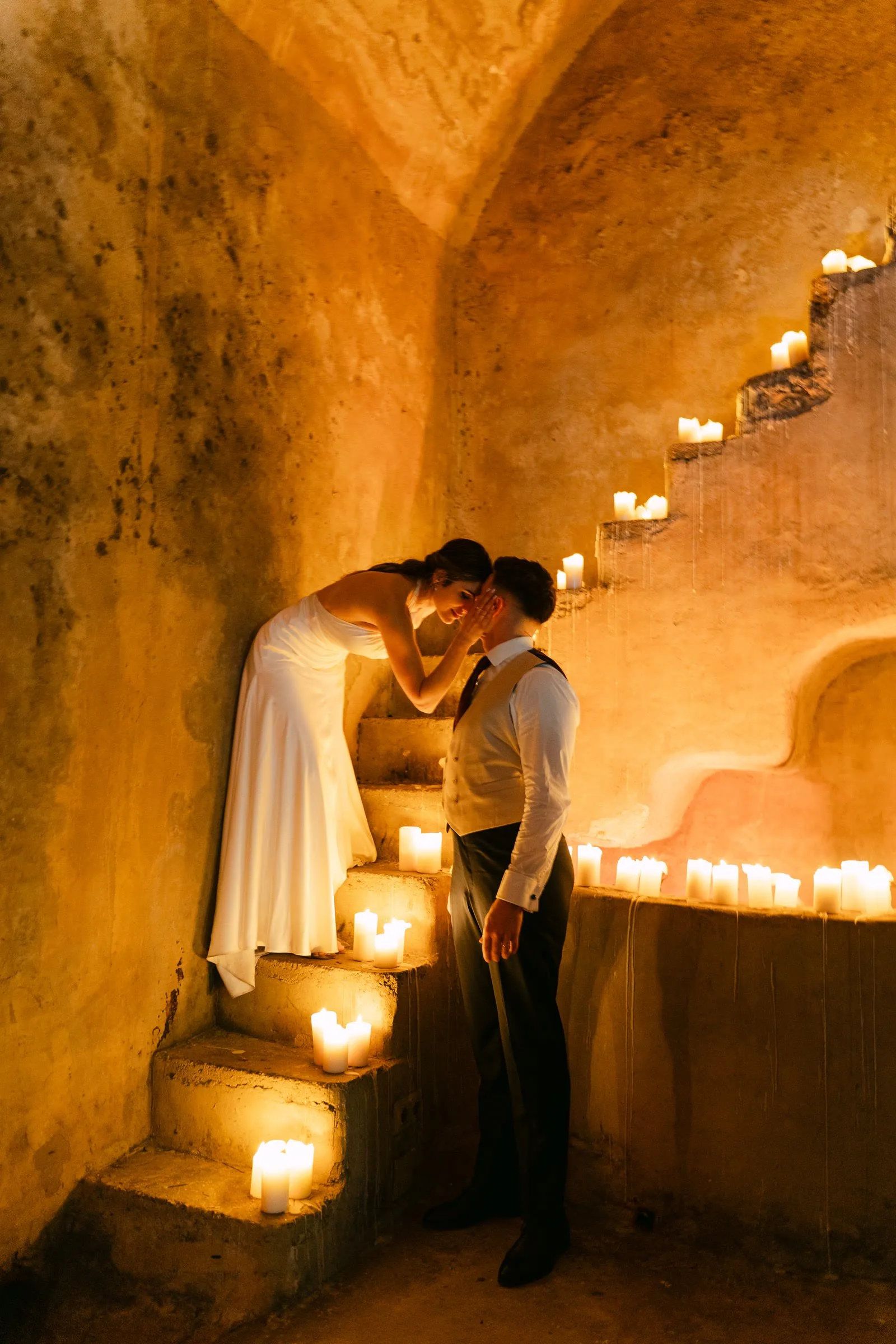
Once the sun has gone, the light is the one the venue gives us. Warm bulbs, festoons and a great many candles flatter skin and look like the night felt. Coloured LED washes, the blue, purple or red uplights that some venues and DJs use by default, turn every face the same colour, in the photographs and in the film. If you love colour, keep it on the walls and the trees, never on the dance floor.
Two more details for the night. Give the speeches a lit place to stand rather than the darkest corner of the room, and ask for a microphone that goes through the sound desk, so the film has clean audio of every word. Both are easy to arrange in a planning meeting and impossible to fix afterwards.
The three mistakes we see most
An outdoor ceremony at noon in July: hard light, closed eyes, guests looking for shade and fanning themselves through the vows. A cocktail with no time set aside for the two of you, so the portraits happen at dinner, in the dark. And a dinner that starts before sunset with no pause, so the best light of the year passes while everyone is seated with their backs to it. All three are easy to fix on paper, months before.
Questions we are asked
What time is golden hour for a wedding?
It depends on the date and the place. In southern Europe in June it usually begins between 19:50 and 21:05 and lasts about forty minutes until sunset; further north it starts later and lasts longer. Use the card above for your exact date and venue.
What time should a wedding ceremony start?
Count back from the light: portraits a quarter of an hour before golden hour, fifteen minutes of family photographs before that, and then the length of your ceremony. For a thirty minute ceremony in Mallorca in mid June, that means starting at around 19:30.
How long does golden hour last?
Less than an hour in most of Europe. On the 15th of June it lasts about 38 minutes in Santorini, 46 on Lake Como and over an hour in the Scottish Highlands. In autumn it is shorter.
How long should couple portraits take?
Twenty minutes in the right light is enough for a full gallery and a film sequence. Longer sessions pull you away from your guests and rarely produce better photographs.
When should family photographs be taken?
Straight after the ceremony, in the same place, before guests leave for the cocktail. With a list of eight to ten groups it takes about fifteen minutes.
What is the blue hour?
The short time after sunset when the sun is just below the horizon and the sky turns deep blue. In southern Europe it ends about half an hour after sunset. Ten minutes outside between courses is enough for a last portrait.
Still choosing a date? Send us the venue and the month by letter, and we will reply with the light for that exact day.